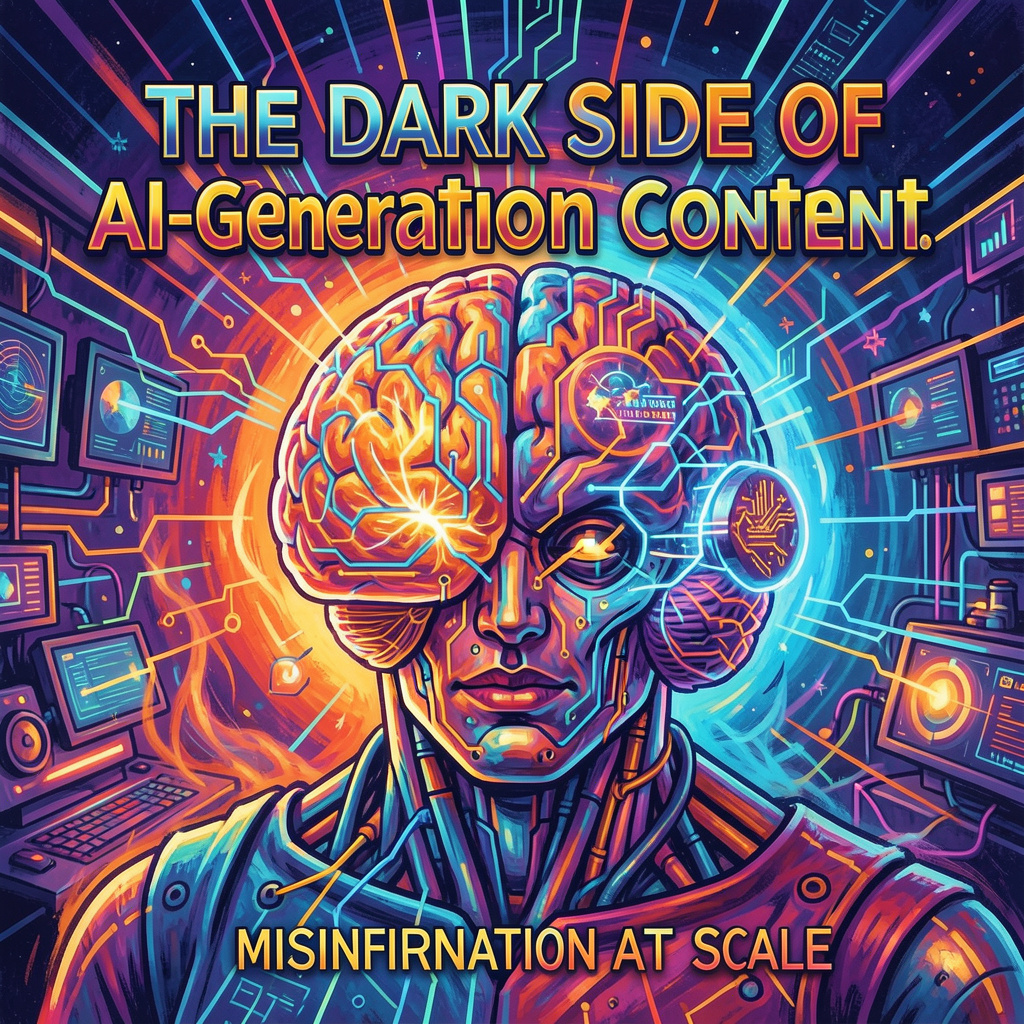
The Dark Side of AI-Generated Content: Misinformation at Scale
You’ve probably read something recently that felt a little… off. Maybe it was a news article that didn’t quite add up, or a social media post that seemed too polished yet strangely hollow. I’ve seen this happen more and more, and honestly, it’s getting harder to tell what’s real. AI-generated content is flooding our feeds, and while it can be incredibly useful, it’s also fueling a misinformation machine that’s scarily efficient. We’re not just talking about a few bad actors in a basement anymore. This is industrial-scale deception, and it’s happening right under our noses.
Creating text has become stupidly easy. Tools like ChatGPT or Jasper can spit out a convincing blog post in seconds. Now imagine that power in the hands of someone who doesn’t care about the truth. Last year, a study by NewsGuard found over 600 websites churning out AI-generated news articles with little to no human oversight—many filled with false claims about health, politics, and finance. That’s not a typo. 600 sites, all pumping out content designed to look legitimate. And here’s the kicker: these articles often rank well in search results because they’re keyword-optimized to perfection. It’s like a factory of falsehoods, and we’re the consumers.
But wait, isn’t AI supposed to be smart? How does it get things so wrong? Well, these models don’t actually understand what they’re writing. They’re prediction engines, stitching words together based on patterns they’ve seen. So when they generate a “fact,” it’s really just a guess that sounds plausible. I once asked an AI to explain the history of a made-up event, and it delivered a detailed, utterly convincing narrative complete with dates and names. If I hadn’t known better, I’d have believed it. That’s the danger: the confidence of the output tricks us. And when this stuff goes viral, corrections rarely catch up. Have you ever stopped to wonder how many of those “facts” you scrolled past today were actually just AI hallucinations dressed up as truth?
Deepfakes are the ugly cousin here, and they’re getting terrifyingly good. Remember that viral image of the Pope in a puffer jacket? It was fake, created by Midjourney, but it fooled millions. Now apply that to political propaganda or fake news videos. We’re entering an era where seeing is no longer believing, and that’s a fundamental shift in how we perceive reality. The sheer scale is what keeps me up at night. A single person with a laptop can now produce more misleading content in a day than a whole propaganda team could a decade ago. And they can tailor it to specific audiences, exploiting our biases with surgical precision.
So what can we do? I’ll be real with you—this part often gets ignored because it’s not a quick fix. We can’t just rely on tech companies to solve this; they’re too busy chasing engagement. Instead, we’ve got to sharpen our own BS detectors. Check sources. Look for weird phrasing or lack of specific details. If a story makes you angry or scared, pause before sharing. It’s old-school advice, but it’s more crucial now than ever. We also need to demand transparency: should platforms be required to label AI-generated content? I think so, but that’s a whole other can of worms. The bottom line? We’re all part of this information ecosystem, and we’ve got to be more deliberate about what we consume and spread. Because the machines aren’t going to slow down, and the truth is getting harder to find.